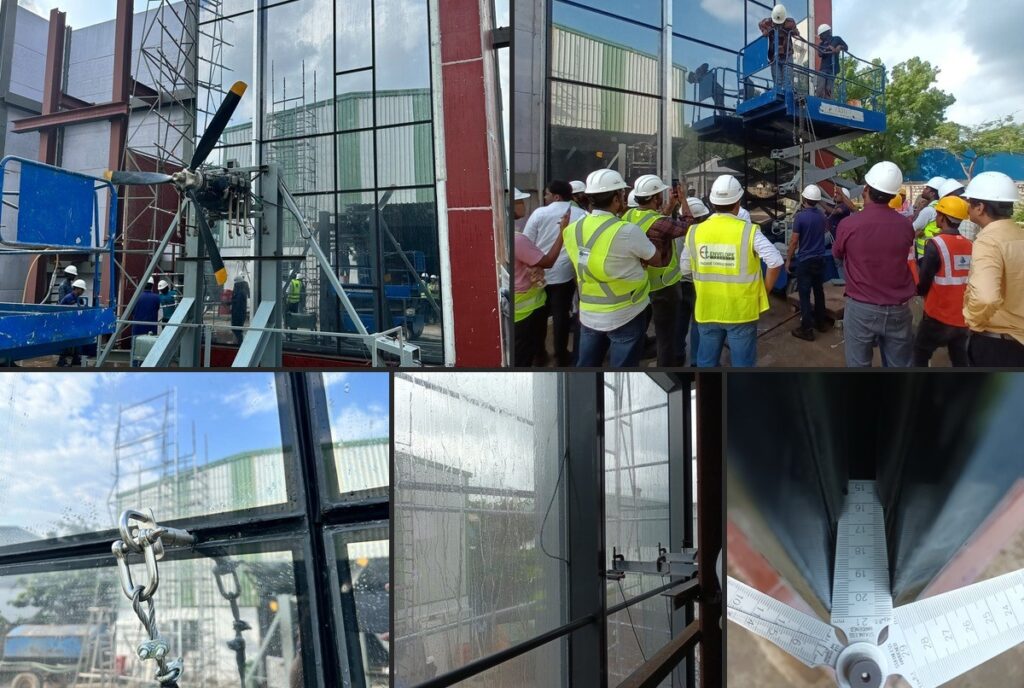
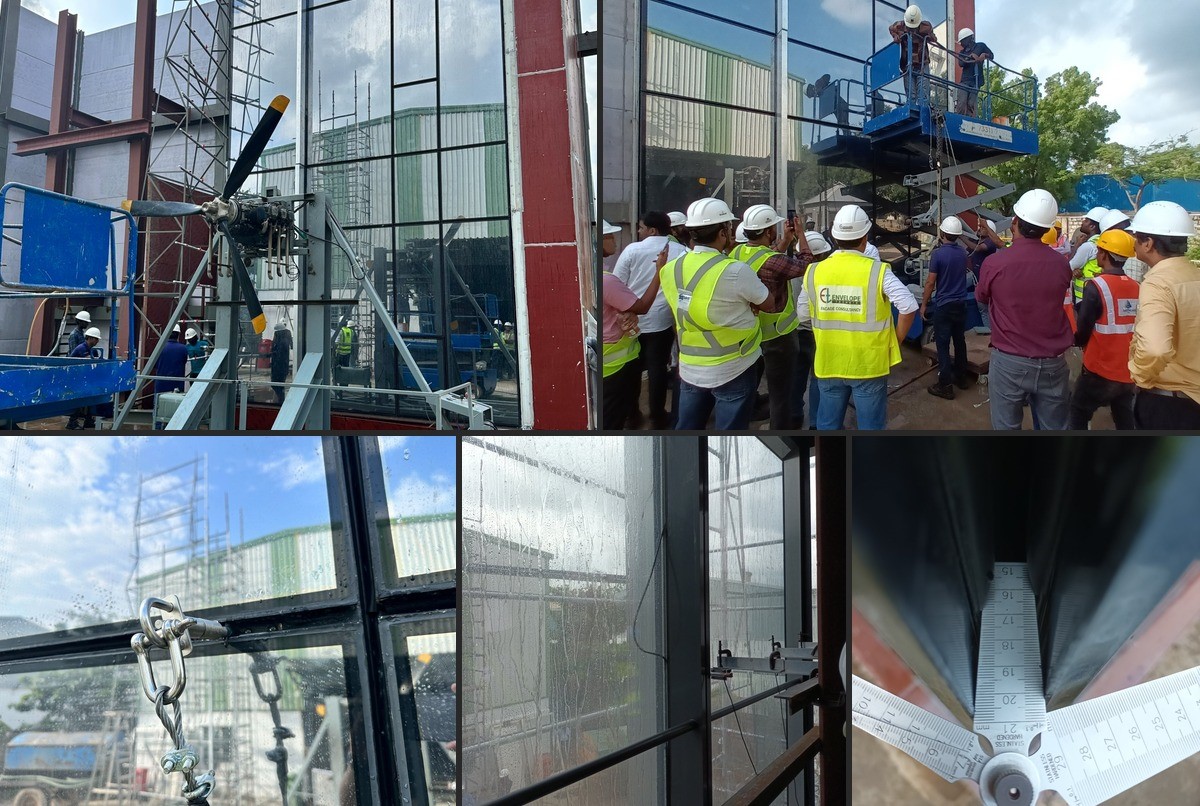
What Is Building Envelope Performance Testing? – Air, water, wind & thermal testing explained

Before a building’s façade is installed across thousands of square metres, how do you know it will actually perform? Building envelope performance testing validates a façade system’s resistance to wind, water, air leakage, and thermal movement before it goes on the building.

1. What Is the Building Envelope?

The building envelope is the physical barrier between the conditioned interior and external environment. It includes:
  • Curtain walls and window walls
  • Cladding systems (metal, stone, composite panels)
  • Roof systems and skylights
  • Doors, louvres, and openings
  • Waterproofing membranes and sealants

2. Types of Performance Tests

Test Type What It Measures Standard
Air Infiltration Air passing through the system under pressure differential ASTM E283 / IS 15251
Water Penetration (Static) Water penetration at a defined static pressure (simulates rain) ASTM E331 / EN 12155
Water Penetration (Dynamic) Water resistance under cyclic pressure (simulates storm gusts) AAMA 501.1 / ASTM E547
Structural (Wind Load) Deflection within limits and integrity under wind pressure ASTM E330 / EN 12179
Thermal Cycling Accommodation of thermal expansion/contraction without failure AAMA 501.5
Seismic Racking Accommodation of inter-storey drift in seismic events AAMA 501.6 / IS 1893
Acoustic Performance Sound reduction (dB) provided by the façade system ISO 10140 / IS 9901
Anchor Pullout Load capacity of façade fixing anchors in the structural substrate ASTM E488 / site-specific
Glass Railing Performance Structural integrity of glass balustrade systems under horizontal top-rail load and in-fill pressure; barrier load capacity; post, channel, and base-plate fixing adequacy; deflection limits BS 6180 / BS 6399-1 / IBC 1607.8 / NBC India

3. What Is a Mock-Up Test?

A full-scale mock-up of the façade system is fabricated at a specialist test facility, replicating a representative section of the actual building façade including all joints, interfaces, corners, and fixings.

🔬  The Mock-Up Process

1. Define mock-up scope (size, system types, interfaces to be tested) 2. Review and approve mock-up drawings and calculations 3. Fabricate and install mock-up at test facility 4. Witness testing against defined performance criteria 5. Evaluate results — pass/fail against project specification 6. Recommend system improvements if any tests fail 7. Re-test (if required) after modifications

4. Why Is Performance Testing Important?

 
Without Testing With Performance Testing
Water ingress discovered only after installation — remediation: ₹1–10 Cr System proven watertight before installation — zero post-completion remediation
Wind-induced deflection causes glass breakage — safety risk + replacement Structural performance confirmed before construction proceeds
Thermal movement cracks sealants — ongoing maintenance cost Cycling test confirms sealant accommodates movement
LEED/IGBC certification fails — reputational and financial damage Thermal test data submitted as evidence for green building certification
5. Field Performance Testing at Site
Unlike laboratory mock-up tests carried out before installation, field tests are conducted on the installed facade at site. They verify that actual construction matches the performance demonstrated at mock-up stage and identify any site-specific defects before practical completion.
Field Test What It Covers Standard
Field Hose Water Penetration Testing at Site Directed nozzle hose applied to installed window frames, curtain wall joints, sill/head interfaces, and perimeter seals at site. Water sprayed at defined flow rate and nozzle angle; interior inspected simultaneously for ingress. Covers individual units, butt joints, corner interfaces, and sealant laps. Rapid method for screening large installed facade areas. AAMA 502.2 Voluntary Specification for Field Testing of Newly Installed Fenestration Products
Field Water Penetration Performance Testing (With Chamber) Sealed pressure chamber clamped to the exterior face of the installed facade. Water sprayed onto the surface while a static air pressure differential is applied, replicating wind-driven rain. More rigorous than hose testing; pressure held at typically 20-50% of design wind pressure. Required on high-rise and high-performance projects; tests one bay at a time with pass/fail recorded per location. AAMA 501.2 Field Check of Metal Storefronts, Curtain Walls, and Sloped Glazing Systems for Water Leakage
Hose Test  AAMA 502.2 Chamber Test  AAMA 501.2
+ Quick to set up; no specialist equipment + Covers large facade areas rapidly + Good for joints, seals, sills, interfaces – No pressure differential; less severe than wind-driven rain + Replicates wind-driven rain with pressure differential + More rigorous; closer to lab mock-up test + Required on high-rise and high-performance projects – Requires chamber and operator; tests one bay at a time
EnvelopeTechnik Recommendation For most projects we recommend combining both: hose testing (AAMA 502.2) across the full facade for broad screening, followed by chamber testing (AAMA 501.2) on a representative sample of bays (typically 5-10% of total) and all critical interfaces. Field test findings are documented in a formal site test report with pass/fail status, photographic evidence, and remediation recommendations.
🏗️  EnvelopeTechnik’s Role in Testing EnvelopeTechnik has witnessed performance mock-up tests for curtain wall, structural glazing, unitized panels, and bespoke façade systems across India and internationally. We define criteria, review fabrication, attend all tests as your independent representative, and provide clear pass/fail assessments.  contact@envelopetechnik.com  |  +91 99129 88116