What Does a Façade Consultant Do? A complete guide for developers, architects & contractors
If you’ve ever wondered why high-rise towers look the way they do — or why some buildings perform better in heat, wind, and rain than others — the answer often lies with one specialist: the façade consultant. This article explains exactly what a façade consultant does, when to hire one, and why it matters for your project.
1. What Is a Façade Consultant?
A façade consultant (also called a façade engineer or building envelope consultant) is a specialist who designs, engineers, and oversees the external skin of a building — everything from glass curtain walls and metal cladding to stonework, waterproofing, and window systems.
Unlike a structural engineer (who focuses on the building’s skeleton) or an architect (who focuses on form and aesthetics), a façade consultant bridges both worlds — ensuring the building’s exterior is beautiful, structurally sound, thermally efficient, watertight, and cost-effective.
Industry Definition
According to the Society of Façade Engineers (SFE): 'Façade Engineering is the art of resolving aesthetic, environmental, and structural issues to achieve the enclosure of habitable space.' It sits at the intersection of architecture, structural engineering, material science, and building physics.
2. What Does a Façade Consultant Actually Do?
The scope of a façade consultant spans the entire project lifecycle. Note that at Concept / Schematic Design stage, the scope is significantly broader than most clients realise — see the expanded detail below.
| Project Stage | What the Façade Consultant Does | Why It Matters |
|---|---|---|
| Concept / Schematic Design |
access, maintenance walkways) |
|
| Detail Design |
|
|
| Tender & Procurement |
|
|
| Construction |
|
|
| Completion & Handover | Conducts snag inspections, reviews as-built drawings, compiles warranties | Protects client’s long-term investment |
| Post-Occupancy | Annual inspections, failure investigations, remedial advice | Extends building life and maintains performance over decades |
3. Key Services
20%
Façade Cost Share
of total construction cost
40%
Risk Reduction
fewer defects with consultant
15%-25%
Value Savings
from value engineering
- Curtain wall system design — stick, unitized, structural glazing, and hybrid systems
- Building envelope performance analysis — thermal, solar, acoustic, wind load, and water penetration
- BIM façade coordination — LOD 200 to LOD 400, Revit, Rhino & Grasshopper for complex geometry
- Façade peer review — independent technical check of design drawings, calculations, and specifications
- BMU and façade access system design — gondola, davit, rope access, and maintenance walkway strategy
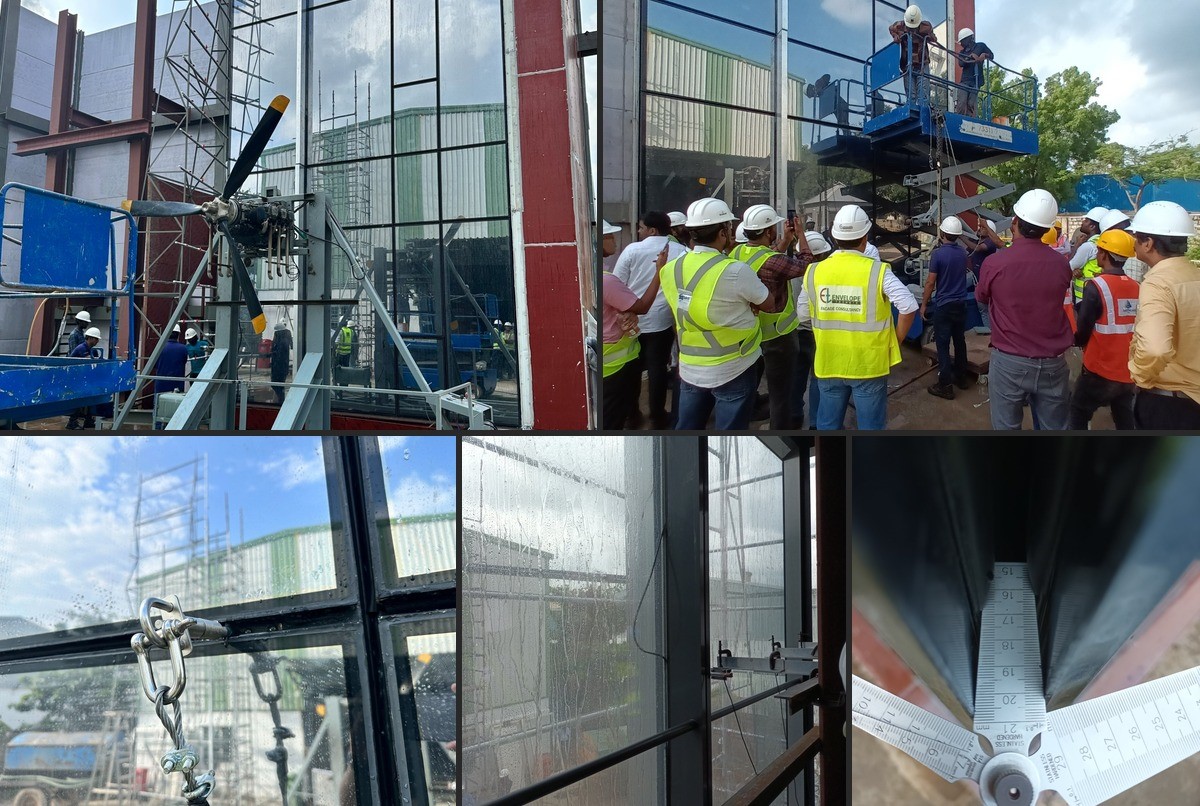
- Mock-up testing supervision — visual mock-up, laboratory performance testing, and site water/air testing
- Value engineering — exploring material alternatives, optimising panel sizes, and reducing wastage without compromising design intent
- Wind load zoning and optimisation — mapping façade into load zones to right-size frame and glass specifications
- Tender management — qualified vendor lists, tender drawings, BOQ by wind zone, technical query resolution, and bid evaluation
- Construction stage services — shop drawing review, structural calculation check, site and factory inspections, RFI resolution
- Building restoration and remediation — assessment, investigation, and repair strategy for existing façades
- Annual inspections and post-occupancy advisory — planned maintenance schedules and defect investigations
4. Real-World Example — EnvelopeTechnik
Project: Goa International Airport, Mopa
EnvelopeTechnik provided complete façade consultancy for the new Goa International Airport. Scope included curtain wall glazing system design, structural coordination, material specification, mock-up testing, and construction supervision. The façade was engineered to withstand coastal wind loads and salt-laden air while delivering the architect's vision.
5. When Should You Hire a Façade Consultant?
The earlier, the better. Engaging a façade specialist during schematic design significantly increases the chance of achieving design intent, budget targets, and performance outcomes.
Warning
Waiting until construction has started to engage a façade consultant is one of the most costly mistakes on complex projects. Changes at construction stage cost 10–100x more than changes at design stage.
6. Frequently Asked Questions
Is a façade consultant the same as an architect?
No. The architect designs the overall building form. The façade consultant engineers and delivers the external skin — working alongside the architect.
Do I need one for a small building?
For simple low-rise buildings with standard systems, it may not be essential. For high-rise, complex geometry, or high-performance buildings, a specialist is strongly recommended.
What qualifications should they have?
Typically a background in engineering or architecture with specialist training, or 15–20 years of façade engineering practice. Membership of the Society of Façade Engineers (SFE) is a strong indicator of expertise
About Envelope Technik
EnvelopeTechnik Consultancy LLP — leading façade engineering firm in Hyderabad & Bangalore, India. www.envelopetechnik.com | contact@envelopetechnik.com | +91 99129 88116
How we can help you?
Recent Posts