Unitized vs Stick Curtain Wall – Pros, cons & selection guide for Indian projects
If you’ve decided to use a curtain wall façade, your next major decision is: unitized or stick system? The choice has significant implications for cost, programme, quality, and risk. This guide explains both systems and provides a clear selection framework for Indian project conditions.

1. What Is a Stick Curtain Wall System?
Individual components (mullions, transoms, glass, gaskets, caps) are transported to site and assembled piece by piece on the building face — typically from scaffolding or a gondola.| ✅ When Stick Works Well Best for: Low-to-mid rise buildings (up to ~10 floors); projects with complex or curved geometry; smaller projects; markets where skilled site labour is readily available. |
1A. The True Cost of Stick: Why Cheaper on Paper Often Isn’t
The stick system’s lower quoted rate (₹11,000–14,000/sqm vs ₹12,000–15,000/sqm for unitized) is real — but it reflects only the material and supply cost. On many Indian projects, the total delivered cost of a stick system, once all site expenses are accounted for, closes the gap significantly or reverses it entirely. Here’s why.| 📊 Aluminium Consumption: Stick vs Unitized Aluminium is the single largest material cost in any curtain wall system. The two systems use it very differently: Stick System — Lower aluminium weight per sqm Stick profiles are slender, site-cut extrusions — mullions, transoms, pressure plates, and covers. Typical aluminium consumption runs 7–10 kg/sqm of façade. The profiles are lighter because they carry no panel frame — the building structure itself bears the load between mullion fix points. This is the primary reason the material rate is lower. Unitized System — Higher aluminium weight per sqm Each unitized panel is a self-contained structural frame — stacked male/female interlock profiles at panel edges, plus internal transom and perimeter frame. Aluminium consumption typically runs 9–14 kg/sqm. The additional weight accounts for double-skin interlock profiles, more robust anchoring brackets, and thicker frame members needed to survive crane lifts and maintain flatness across the panel. |
| ⚠️ Why Stick System Is Costly in Total Project Delivery The material saving in a stick system is systematically eroded by five cost drivers that rarely appear in the initial quotation: 1. Labour Cost Every component — mullion, transom, glass unit, gasket, pressure plate, cap — is handled, cut, drilled, fitted, and fixed individually on the building face. A unitized system replaces much of this with factory labour (lower cost per hour, higher throughput). On a 10,000 sqm façade, stick system site labour hours can run 3–5× higher than a unitized installation. Supervision, safety compliance, and rework add further to the site labour bill. 2. Access System Rental Stick installation requires continuous external scaffolding or a building maintenance unit (BMU/gondola) for the full installation period. On a high-rise building, external scaffolding rental for 12–18 months can add ₹600–900/sqm to the project cost — a cost that does not exist in a unitized installation, where panels are craned floor-by-floor with no external scaffold required. 3. Material Wastage Aluminium extrusions delivered to site are cut to length in the field, generating offcut waste that is rarely recovered efficiently. Site-cut gaskets, sealant, and setting block materials add further. Industry benchmarks indicate stick system site wastage at 8–15% of material value, versus 2–4% in a factory-controlled unitized operation where CNC cutting eliminates most offcut waste. 4. Quality Repairs and Defect Rectification Assembly on an exposed building face — subject to heat, wind, rain, and variable site skill levels — produces inconsistent gasket seating, misaligned pressure plates, and sealant defects that are invisible until post-handover water testing. Remediation requires re-mobilising access equipment and skilled labour. On Indian commercial projects, post-installation defect costs on stick systems average 2–5% of contract value — a cost borne either by the contractor or passed back to the client through variation orders. 5. Time Cost (Programme Delay) Stick installation is purely sequential — façade work cannot begin until structure is sufficiently advanced, and internal fit-out cannot begin until façade is weather-tight. Unitized allows factory production to run in parallel with structure, compressing the overall programme by 3–6 months on a typical high-rise. For commercial projects where earlier occupation means earlier rental income, this programme saving alone can outweigh the entire material cost premium of a unitized system. The bottom line: On buildings above 10 floors, when all five factors are priced into a total cost of ownership model, unitized systems routinely deliver equal or lower total cost — with significantly better quality and programme outcomes. |
2. What Is a Unitized Curtain Wall System?
Complete floor-to-floor panels (typically 1.2–1.5m wide × floor-to-floor height) are factory-assembled, tested, and glazed, then craned into position on the building and ‘clicked’ together. Assembly on the building face is minimal.| ✅ When Unitized Works Well Best for: High-rise buildings (above 10 floors); fast-track programmes; remote or difficult access sites; repetitive floor plates; projects where factory quality control is critical. |
3. Head-to-Head Comparison
| Factor | Stick System | Unitized System | Verdict |
| Cost (India 2025) | ₹11,000–14,000/sqm | ₹12,000–15,000/sqm | Stick slightly cheaper |
| Installation Speed | Slow — sequential site assembly | Fast — parallel factory + site work | Unitized wins |
| Quality Control | Variable — weather and site conditions affect assembly | Consistent — factory-controlled environment | Unitized wins |
| Suitable Height | Best up to ~10 floors | Ideal above 10 floors | Project-specific |
| Complex Geometry | More flexible — site adjustments possible | Less flexible — panel geometry locked in factory | Stick wins |
| Programme Risk | High — site-assembled; weather-dependent | Low — factory work parallel to structure | Unitized wins |
| Airtightness | Good if assembled correctly; variable | Excellent — factory-tested gaskets and seals | Unitized wins |
| Scaffolding | Extensive external scaffold or gondola required | Minimal — craned from floor edge | Unitized wins |
| Single Panel Replacement | Easier — components replaced in-situ | Requires specialist equipment | Stick easier |
4. Real-World Application — EnvelopeTechnik
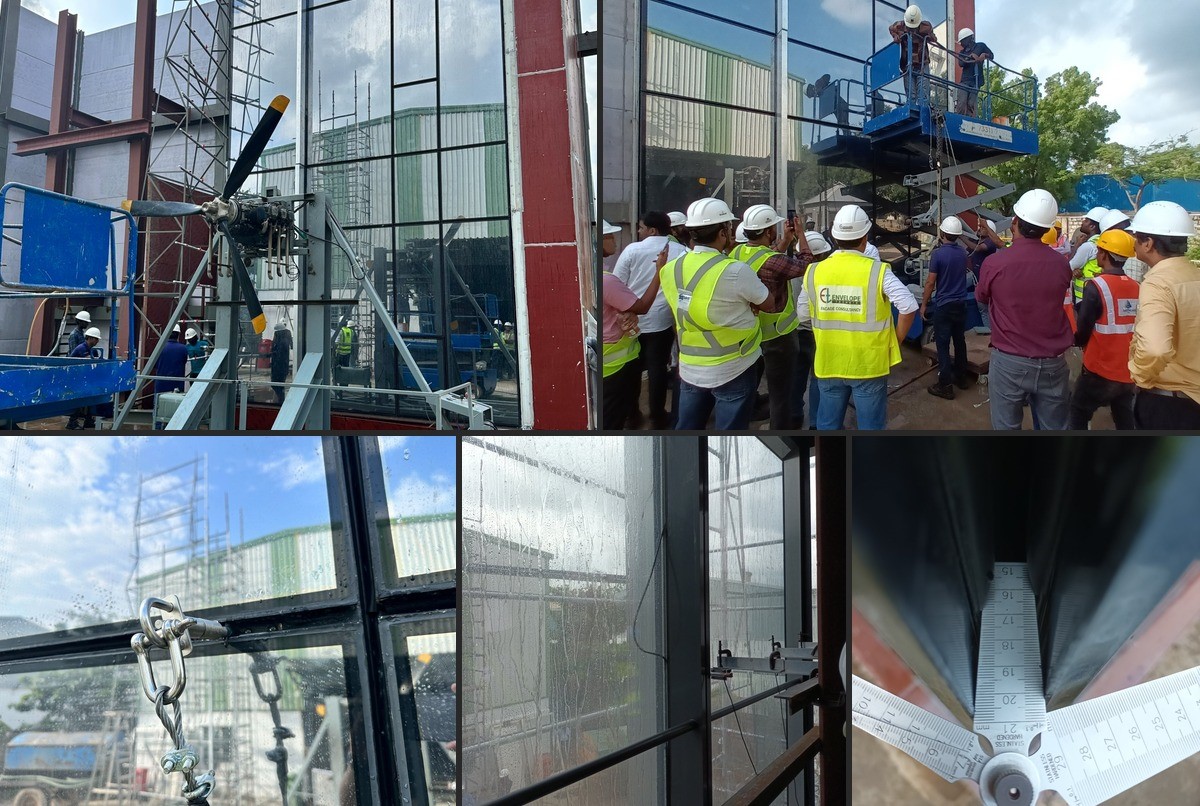
| 🏢 KRC Hetero Commerzone, Hyderabad EnvelopeTechnik specified and supervised a unitized curtain wall system for this premium commercial development. Unitized was selected for superior quality control, speed on a fast-track programme, and proven airtightness performance. Horizontal aluminium fins were integrated into the unitized panel design for shading and aesthetics. |
5. Selection Framework
| Project Condition | Recommended System | Reason |
| Building height > 10 floors | Unitized | Programme speed; quality control; reduced scaffold risk |
| Building height < 10 floors | Stick | Lower cost; factory mobilisation not cost-effective |
| Fast-track programme (< 18 months) | Unitized | Factory production runs parallel to structure |
| Complex / curved geometry | Stick | Site adjustment flexibility |
| Remote site / difficult access | Unitized | Minimal site labour and scaffolding |
| Budget-constrained project | Stick | Lower per-sqm cost |
| High quality / low defect tolerance | Unitized | Factory quality control; pre-tested panels |
| Small project (< 2,000 sqm façade) | Stick | Factory mobilisation cost makes unitized uneconomical |
| 📞 About EnvelopeTechnik EnvelopeTechnik has specified and supervised both unitized and stick curtain wall systems across India. We provide system-agnostic recommendations — always based on what’s best for your specific project. contact@envelopetechnik.com | +91 99129 88116 |
How we can help you?
Recent Posts

March 20, 2026
10:48 am
March 20, 2026
10:15 am