Best Façade Systems for Coastal Buildings in India – Durability, performance & material selection for salt-air environments
India’s coastline stretches over 7,500 kilometres — and some of the country’s most prestigious buildings sit within it. Coastal buildings face a uniquely hostile environment: salt-laden air, high humidity, UV radiation, and cyclonic wind loads create challenges that standard façade systems simply aren’t designed to handle.
7,516 km India’s Coastline among world’s longest | 3–5x Salt Corrosion faster than inland locations | Up to 250 km/h Wind Speeds cyclone-prone zones |
1. Unique Challenges of Coastal Environments
| Environmental Factor | Impact on Façade | Design Response |
| Salt-laden air | Accelerates corrosion of aluminium, steel, and fixings | Marine-grade alloys; PVDF/anodised coatings; stainless steel fasteners |
| High humidity | Moisture ingress; condensation; mould | Ventilated rain screen design; vapour barriers; closed-cell insulation |
| UV radiation | Material degradation; colour fade; sealant breakdown | UV-stable coatings; fluoropolymer paints; high-UV-resistance sealants |
| Wind and cyclones | High suction/pressure loads; wind-driven rain | Elevated wind load calcs (IS 875 Part 3); pressure-equalized systems |
| Thermal cycling | Expansion/contraction fatigue; sealant failure | Adequate movement joints; flexible structural silicone; thermal modelling |
| Sand abrasion | Surface scratch and erosion of finishes | Hard anodised or PVDF finishes; sacrificial surface protection |
2. Recommended Façade Systems
System 1: High-Performance Unitized Curtain Wall with Marine-Grade Aluminium
The gold standard for high-rise coastal buildings. Marine-grade 6063-T6 or 6061-T6 aluminium alloy, PVDF coating (minimum 70% PVDF), and marine-grade structural silicone. Pressure-equalized drainage prevents water ingress even in cyclonic conditions.
- Best for: High-rise offices, hotels, airport terminals
- Cost: ₹8,000–15,000/sqm installed | Life expectancy: 30–50 years
System 2: Fibre Reinforced Concrete (FRC) Rain Screen Cladding
FRC panels are inherently resistant to salt corrosion, fire, and moisture. Combined with a ventilated cavity, they provide excellent long-term durability with minimal maintenance.
- Best for: Residential podiums, hospitality, mid-rise buildings
- Cost: ₹6,500–9,000/sqm | Life expectancy: 40+ years
System 3: Composite Metal Panels with Fluoropolymer Coating
Aluminium composite panels with PVDF/fluoropolymer coating provide durable, lightweight cladding. Coating quality is critical in coastal environments — specify minimum 70% PVDF with a 25-year coating warranty.
- Cost: ₹7,500–9,500/sqm installed
System 4: Branded High-Performance Aluminium Window & Door Systems
For coastal buildings where individual window and door openings are required alongside the main facade system, branded European aluminium systems offer significantly superior performance over generic Indian fabrications. Systems from manufacturers such as Schüco, Technal, Alumil, Reynaers, and YKK AP are engineered with precision-extruded thermally broken profiles, factory-applied PVDF coatings, and multi-chamber sections that prevent condensation and salt ingress. Hardware and weather seals are specified for coastal durability, and profiles are available in marine-grade alloys with anodised or high-build PVDF finishes as standard.
- Best for: Premium residential, hospitality, airports, high-specification commercial buildings requiring openable windows and doors
- Brands: Schüco (Germany), Technal (France), Alumil (Greece), Reynaers (Belgium), YKK AP (Japan) — all with India-based fabricators and supply chains
- Key advantage: Certified air/water/wind test data available per system series; thermal performance (U-value) guaranteed; hardware rated for 50,000+ cycles
- Cost: ₹12,000–22,000/sqm installed (system-dependent) | Life expectancy: 30–40 years with minimal maintenance
System 5: Solid Aluminium Sheet with PVDF Finish
Solid aluminium sheet (3mm–6mm) with factory-applied PVDF finish is one of the most durable and corrosion-resistant cladding materials available for coastal facades. Unlike aluminium composite panels (ACP), which have a polyethylene or fire-rated core, solid aluminium sheet is a single-material panel with no delamination risk and superior resistance to impact, fire, and moisture ingress at panel edges. In coastal environments, the absence of a bonded core eliminates the most common failure mode of ACP — edge seal failure leading to core moisture absorption. Panels are typically formed and routed to create cassette profiles, flat panels, or perforated screens, and can be anodised or PVDF-coated in any RAL or custom colour.
- Best for: High-end residential, hospitality facades, feature elements, roof parapets, soffits, column cladding, and any application where ACP fire or delamination risk is a concern
- Key advantages: No delamination risk; full-depth formed edges with no exposed core; PVDF coating bonds directly to aluminium substrate; available in 5005 / 5052 alloy for coastal use; fire classification A2-s1,d0 achievable
- Specification note: Minimum 70% PVDF two-coat system (primer + topcoat); coating thickness ≥35μm DFT; anodised option (25μm minimum) also suitable for coastal; all cut edges to be sealed with compatible edge sealant
- Cost: ₹4,500–8,000/sqm installed | Life expectancy: 35–50 years
System 6: Natural Stone, Terracotta & Porcelain Panels – Coastal Suitability Assessment
These three cladding types have very different suitability profiles for coastal environments. The table below summarises the key considerations for each.
| System | Coastal Rating | Key Considerations | Verdict |
Natural Stone (Granite, Limestone, Sandstone) | ⚠ Conditional | Granite: Highly suitable — dense, low porosity, resistant to salt and UV. Limestone and sandstone: NOT recommended in coastal zones — high porosity allows salt crystallisation inside the stone causing spalling and surface decay within 5–10 years. Ferrous mineral content in some stones causes rust staining. All natural stone requires stainless steel fixings (SS 316), open-joint ventilated cavity, and back-sealing of panels. | Granite: YES Limestone / Sandstone: AVOID |
Terracotta Panels (Extruded clay rain screen) | ✓ Good | High-fired extruded terracotta (e.g. Moeding, Shengda) performs well in coastal climates — inert ceramic material is salt-resistant, UV-stable, and dimensionally stable. Open-joint rain screen system allows cavity ventilation preventing moisture accumulation. Key risk: sub-frame and fixings must be SS 316 (not aluminium or GI); grease contamination during installation causes efflorescence. Natural colour variation is inherent and not a defect. Specify frost-resistant grade for high-altitude coastal sites. | YES — with SS 316 sub-frame and open-joint cavity design |
Porcelain Panels (Large-format sintered / ultra-compact) | ✓ Excellent | Large-format porcelain (e.g. Dekton, Neolith, Lapitec, Kerlite) is among the most salt- and UV-resistant cladding materials available. Near-zero water absorption (<0.1%) makes it inherently resistant to salt crystallisation and freeze-thaw. Surface is scratch, stain, and chemical resistant. Main risks: brittleness during handling and cutting; mechanical fixings (kerf, undercut, or Z-clip) must be specified carefully with SS 316 hardware; avoid adhesive-only fixing on facades >3 floors. Cost is higher than terracotta but justified by performance and low maintenance. | YES — mechanical fixing with SS 316 hardware mandatory |
3. Materials to Avoid in Coastal Environments
| Avoid | Reason |
| Standard aluminium without protective coating | Rapid corrosion in salt air; pitting and structural degradation within 5–10 years |
| Carbon steel fixings without corrosion protection | Rust staining and structural failure within 2–5 years in coastal zones |
| Standard polyester paint finish (PE coating) | Fades within 5 years; chalking and colour change; not warranted for coastal use |
| Standard sealants at primary joints | Brittle in UV; poor adhesion to wet substrates; water ingress risk |
| SS 304 or lower grade fasteners and fixings | Insufficient chloride resistance in coastal salt air; pitting and crevice corrosion within 3–5 years; use SS 316 / 316L minimum for all exposed fixings, cleats, and anchors |
| 3000-series aluminium sheet (3003, 3105) | Inferior alloy for structural and cladding applications; poor compatibility with high-build PVDF coatings; delamination and uneven coating adhesion; specify 5005 / 5052 (sheet) or 6063-T6 / 6061-T6 (extrusions) for coastal use |
| Steel reinforcement within enclosed cavities | Moisture ingress in coastal zones causes accelerated rust; rust expansion cracks cladding panels and fixings; all concealed steel must be hot-dip galvanised or replaced with aluminium or SS structural members |
| GI sheet flashing and GI spandrel back pans | Galvanised iron corrodes rapidly in salt-laden coastal air, particularly at cut edges and fastener holes; rust staining bleeds through cladding joints; replace with aluminium alloy 5052 / 3003 or SS 316 sheet for all flashing and back pans |
| GI anchor fasteners and GI support brackets | Zinc coating on GI anchors fails within 5–10 years in coastal environments; structural anchor failure risk; all primary facade anchors and brackets must be SS 316 or hot-dip galvanised steel with minimum 85μm zinc coating, with EPDM isolation between dissimilar metals |
| GI / aluminium gutters and drainage components | GI gutters corrode from inside out due to retained moisture and salt; aluminium gutters without adequate coating suffer pitting; specify SS 316 gutters, downpipes, and drainage channels for all coastal facade applications; avoid lap joints without sealant |
| Powder coating (PE) on external facade elements | Polyester powder coating (PE) lacks the UV and salt resistance required for coastal external facades; chalking, colour fade, and micro-cracking occur within 3–5 years in coastal salt air; loss of adhesion at cut edges and fastener holes allows moisture ingress and substrate corrosion. Specify minimum 70% PVDF liquid paint coating or high-quality anodising for all external aluminium extrusions, panels, and sheet in coastal environments. PE coating is acceptable for internal or sheltered elements only. |
| PVC gaskets, spacers, and packing in facade assemblies | Standard PVC compounds absorb moisture over time, causing swelling and dimensional creep that compromises joint compression and weathertightness; PVC becomes brittle and shrinks in UV-exposed coastal conditions, opening gaps at primary weather seals. In high-humidity coastal environments, moisture-absorbent PVC packing behind panels and within glazing rebates creates a reservoir for salt-laden water, accelerating corrosion of adjacent aluminium and steel components. Specify EPDM (ethylene propylene diene monomer) gaskets and setting blocks, or silicone-based packing, for all external facade joints, glazing rebates, and structural interfaces. |
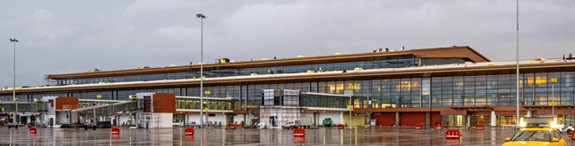
🏢 EnvelopeTechnik Coastal Projects Goa International Airport (Mopa), Trivandrum International Airport, and multiple residential & commercial projects along India’s coasts. We design for coastal durability from day one. contact@envelopetechnik.com | +91 99129 88116 |
How we can help you?
Recent Posts